

If your business operates in a challenging industry or has credit issues, traditional bank loans may seem out of reach. High-risk business loans may fill this gap, providing funding when conventional lenders won't approve your application.
Understanding your options helps you secure the capital needed to grow your business, even when facing higher lending standards or unfavorable industry perceptions.
What is a high-risk business loan?
A high-risk business loan is financing designed for businesses that traditional lenders consider more likely to default.
These loans typically feature higher interest rates and shorter repayment terms. Lenders price these products to offset the increased risk of lending to businesses they view as less stable.
Many lenders create risk tiers that categorize the type of risk an applicant or borrower represents. The simplest would be low-risk, medium-risk or high-risk, but lenders may have many more than that.
Each lender defines the level of risk they are willing to accept. What does that mean for you, as a business owner?
It means you may be rejected by one lender but approved by another.
Which types of businesses are considered high risk?
The industry in which your business operates can be a key factor in whether you can get financing, and the types of financing your business can qualify for.
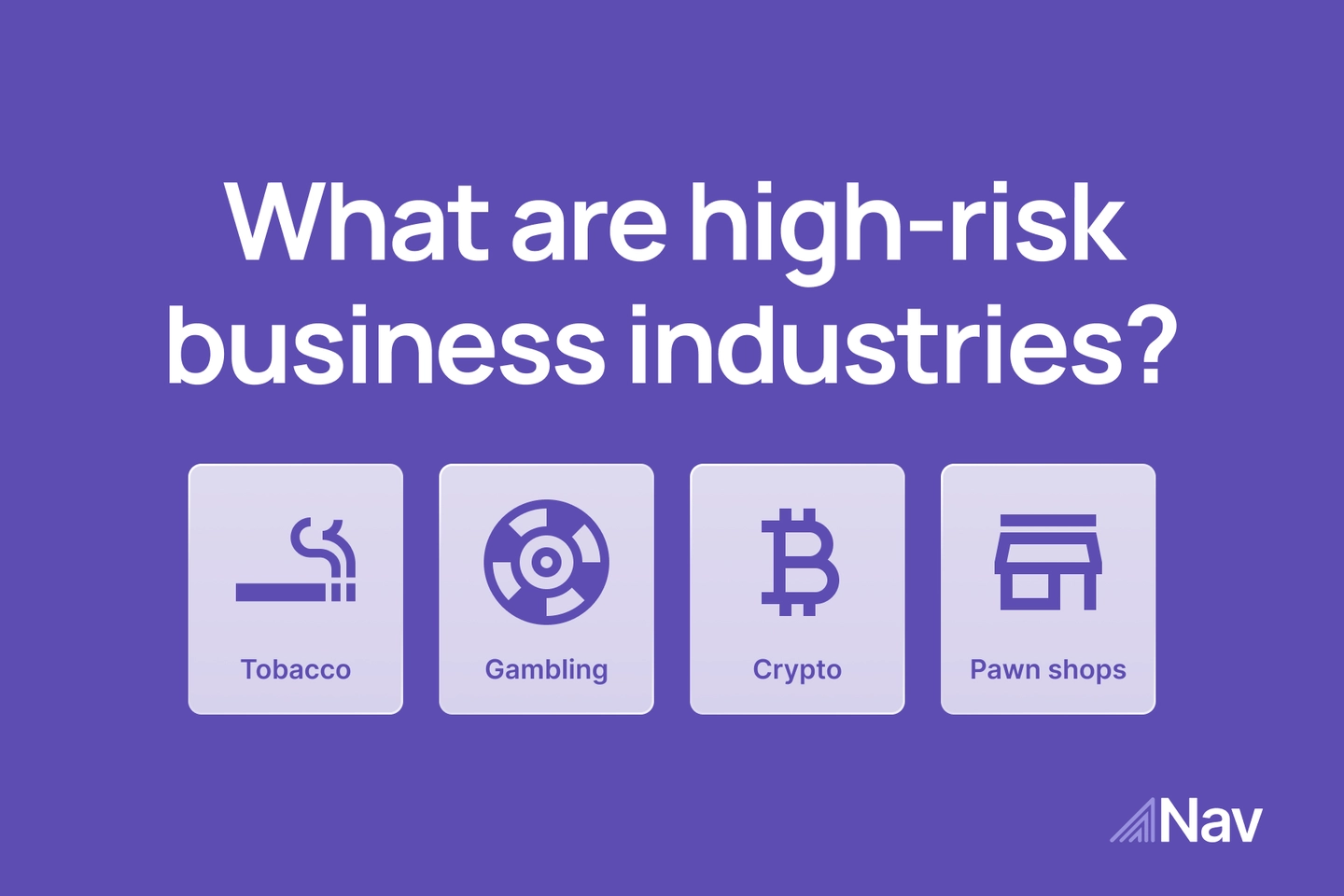
Certain types of businesses often fall into higher risk categories. Each lender is different, but these industries are common examples:
- Adult entertainment and dating services
- Airlines, accommodations, and ticketing agents
- Bail bonds
- Bankruptcy attorneys
- Calling cards and PBX VoIP systems
- Casinos or online gaming
- Collection agencies
- Cryptocurrency
- Dating/porn sites/escorts/massage parlors
- E-tobacco
- Extended warranty
- Financial counseling/credit repair/debt reduction
- Gaming and lotteries
- Golf clubs online
- Home-based gun shops
- Importers and exporters
- MLMs (Multi-Level Marketing)
- Online pharmacy
- Pawn shops
- Pharmaceuticals and online drug providers
- Prepaid debit cards
- Recurring billing/subscriptions
- Subscription services (magazines, collectibles, etc.)
- Telemarketing
- Timeshares
- Tobacco/E-cigarettes/cannabis products
- Travel companies
- Used car companies
Each lender defines risk differently, and being included on this list doesn’t guarantee you’ll be approved or denied for funding. These categorizations are not regulatory or legal designations, but based on typical lender underwriting policies.
Businesses are usually identified with SIC or NAICS codes. These are industry codes used to identify the type of business. If you check your business credit, double check to make sure yours is correct.
Why lenders consider some businesses high risk
There are several factors that may land your business in the high-risk category, including:
- High failure rates: Some industries experience higher rates of business closure or bankruptcy. Business credit scores can include industry when calculating credit scores.
- Regulatory issues: Businesses in heavily regulated sectors face compliance risks and potential legal challenges. These businesses may have trouble getting insurance as well as financing.
- Cash flow instability: Industries with seasonal fluctuations or unpredictable revenue streams may be considered more risky.
- Fraud potential: Businesses with higher rates of chargebacks or disputed transactions will find it harder to get a merchant account as well as financing.
- Economic sensitivity: Companies that struggle during economic downturns or market changes will find fewer lenders willing to extend credit.
- Litigation risk: Lenders pay attention to industries prone to lawsuits or liability issues. Certain types of products, such as supplements, medications, or even children’s products, may fall into this category.
Funding options for high-risk businesses
Even high-risk businesses may find multiple financing alternatives, each with pros and cons.
Online business loans
Online lenders often offer fast financing options with more flexibility than traditional banks. The application process is often simpler, and you can typically get an answer quickly. These lenders may focus more on business performance and cash flow than credit or industry classification alone.
Not all online lenders make high-risk loans. But some do. Some may even specialize in industries that banks and other lenders consider risky.
Merchant cash advances (MCAs)
Businesses with strong sales may qualify for merchant cash advances, which provide funding against future credit card sales. MCAs may offer fast access to capital but typically come with high costs, along with daily or weekly payment requirements.
This option works best for businesses with consistent credit card and debit card transaction volume, as payments are automatically deducted from your merchant account.
Invoice factoring and receivables financing
If your business sells to other companies (B2B), invoice factoring or financing may be viable options. With factoring, you sell unpaid invoices to a factoring company at a discount for immediate cash. The factoring company then collects payment from your customers.
Invoice financing allows you to use unpaid invoices as collateral for a loan.
Equipment financing
Equipment financing and leasing can help preserve cash flow for businesses needing machinery, computers, or other assets. Because the equipment serves as collateral, these options may be more accessible for high-risk businesses.
Tax benefits may also apply, making this an attractive option for capital-intensive businesses.
Hard money loans
A popular source of funding for high-risk businesses, like real estate investors who fix and flip properties, or cannabis businesses, hard money loans are often made by private investors willing to take more risk. These lenders often don’t care about credit scores; instead, they are interested in the details of the deal they are funding.
Learn more: Hard money loans with 100% financing
Funding options comparison
Option | Typical approval Time | Typical rates* (will vary) | Pros | Cons |
Online loans | 1–7 days | 15%–50% APR | In many cases, fast approval, flexible terms | Rates can be high for some options |
Merchant cash advances | 1–3 days | 20%–80% APR | Very fast funding if qualified | Often expensive, daily payments |
Invoice factoring | 1–3 days | 1%–5% per month | No debt on balance sheet | Only B2B invoices |
Equipment financing | 3–14 days | 8%–30% APR | Equipment as collateral | Limited to equipment purchases |
Hard money loans | 1–7 days | 12%–25% | In many cases, fast funding based on property deal | Higher rates, short-term financing |
Note: APR ranges vary widely depending on lender, business profile, and loan type. These examples are not guaranteed rates.
Rates, terms, and costs for high-risk business loans
High-risk business financing comes with premium pricing to compensate lenders for that risk. This may include:
Higher interest rates: Rates may be in the range of 20%–80% APR for merchant cash advances, or 15%–50% for online loans, though rates vary.
Shorter terms: Repayment periods typically range from six months to two years versus 5–10 years for traditional small business loans.
Frequent payments: Financing may require weekly or daily payments rather than monthly payments, and payments may be deducted from the business merchant account or bank account.
Fees: Origination fees, factor fees, or service charges may add significant costs.
Personal guarantees: A personal guarantee means you may be personally responsible for repaying the debt if your business cannot.
How to qualify for a high-risk business loan
These steps may help to improve your approval odds:
1. Check minimum revenue and time-in-business requirements
It is not unusual for lenders to require at least $100,000 in annual revenue and 6-12 months in business, though requirements vary by lender and loan type. Many lenders post minimum revenue requirements on their site. If not, it doesn’t hurt to ask.
2. Prepare business bank statements
Gather your most recent 6 months of business bank statements. (You may only need to share the most recent 3 months of statements, but it doesn’t hurt to be ready to share more.)
It’s very common for lenders and financing companies to require these to verify revenue and assess financial stability.
3. Highlight collateral or assets
If you have equipment, inventory, or other business assets, document their value. Pledging collateral may improve your chances of getting approved, and may mean lower interest rates.
4. Understand industry risk
While you may not be able to change the industry in which your business operates, you should understand the risks associated with your industry, and seek out specialized financing if necessary.
Make sure the NAICS and SIC codes listed on your business credit reports are accurate so your business isn’t categorized incorrectly.
5. Be ready for higher documentation requirements
High-risk lenders may request additional documentation like contracts or detailed financial statements and projections to better assess your business. Be prepared to respond quickly if the lender asks for additional information.
Pros and cons of high-risk business loans
Here are some of the most common pros and cons of these loans:
Pros
- In many cases, fast approval and funding when traditional lenders say no
- Flexible qualification criteria beyond just credit scores
- Multiple financing options to match business needs
- May help establish business credit history with successful repayment
- Access to capital during growth phases or cash flow gaps
Cons
- Often higher interest rates and fees than traditional loans
- Shorter repayment terms create larger monthly payments
- Risk of debt spiral if cash flow doesn't improve
- Personal guarantees may put personal assets at risk
- May require daily or weekly payments that strain cash flow
Alternatives to high-risk business loans
A high-risk business loan may not be your best option. You may want to explore alternatives:
Business credit cards
Business credit cards may be an excellent option for business owners that fall into many higher risk categories. Many card issuers don’t care if your business is a startup, for example, or whether your business operates as a sole proprietorship. Also, industry restrictions are not common.
The main two qualifications required for many business credit card issuers are:
- Good to excellent personal credit scores
- Sufficient income from all sources, not just the business
Every issuer is different, of course, so you’ll want to review requirements before you apply.
Nav can make it easy to find business credit cards based on your business data. Find a business credit card now.
Business charge cards
Some business charge cards have flexible qualification requirements. With a charge card, you pay your balance in full.
Secured business credit cards
If your hurdle is low personal credit scores, you may want to consider a business secured credit card. Most business credit cards can help build credit if you pay on time and keep balances low.
Crowdfunding and peer-to-peer loans
Crowdfunding and P2P platforms connect businesses directly with individual investors willing to take on higher risk for potentially higher returns. These options may work for businesses with compelling stories or innovative products.
Success depends on your ability to present your business case effectively and attract investor interest.
Microloans and CDFI lenders
Community Development Financial Institutions (CDFIs) and microlenders (which are often nonprofit lenders) may focus on underserved businesses and be more flexible with industry restrictions. These lenders often provide smaller loan amounts with more personalized service and business development support.
Loan amounts typically range from $500 to $50,000, making them suitable for smaller funding needs.
How to avoid predatory lenders
Borrowers who are having trouble getting financing are targets for scammers and predatory lenders. You’re at especially high risk if you need financing asap because you’re less likely to shop around.
Here are some tips for protecting your business:
- Research lender reputation: Check online reviews, Better Business Bureau ratings, and verify state licensing before applying. Look for complaints about hidden fees, aggressive collection practices, or unresponsive customer service.
- Verify contact information: Ensure the lender has a physical business address and legitimate phone numbers. Look up the address on Google maps to see if there is a business located at that address.
- Avoid "guaranteed approval": Legitimate lenders always evaluate creditworthiness and business performance in some way. Be suspicious of lenders who promise approval without reviewing your finances or credit history.
- Watch for upfront fees: Never pay money before receiving loan proceeds. Legitimate lenders deduct fees from the loan amount or include them in your payment schedule, not as separate upfront charges. Scammers will often require you to pay upfront “processing fees” or “insurance” fees. And if they ask you to pay those fees using gift cards, you’re not dealing with a legitimate lender.
- Read all terms carefully: Understand payment schedules, default triggers, prepayment penalties, and what happens if you miss payments. Pay special attention to automatic renewal clauses or confession of judgment provisions.
- Get everything in writing: Avoid lenders who won't provide written loan agreements or try to conduct business entirely over the phone. All terms, rates, and fees should be clearly documented before you sign.
- Be cautious of pressure tactics: Take time to review offers and compare multiple options. Legitimate lenders won't pressure you to sign immediately or claim their offer expires within hours.
- Compare total payback: How much will you pay when you pay back the entire loan? Calculate the true cost including all fees, interest, and penalties to understand what you'll actually pay. A loan with a lower rate but high fees may cost more than one with higher rates. Nav’s business loan calculators can help here.
For more details, read Nav’s guide, How to verify a loan company’s legitimacy & avoid scams.
Build credit to improve your options
Strong business and personal credit expands your financing options and can help you qualify for better terms. Here are basic steps to get you headed in that direction.
For details on how to build business credit, read Nav’s article, How to build business credit fast.
Separate business and personal finances
If you want to separate your credit, it helps to separate your other finances as well.
If possible, establish a clear separation by:
- Incorporating your business or forming an LLC
- Getting an Employer Identification Number
- Getting a D-U-N-S® Number
- Opening a dedicated business bank account for all business transactions
Taking these steps can help you maintain a clearer separation, helping make taxes easier (which is always a win).
Work with suppliers that report to business credit bureaus
Seek out vendors offering net-30 payment terms that report to business credit bureaus. Pay these accounts on time to build a positive payment history.
Monitor business credit reports regularly
Review reports from major commercial credit bureaus to track your progress, identify errors, and catch potential fraudulent activity early.
Building strong business credit takes time but can open doors to more financing options. Invest the time now to build your business credit history so it will be a resource you can tap as your business grows.
Frequently asked questions
Rate this article
This article currently has 2 ratings with an average of 4 stars.

Gerri Detweiler
Education Consultant, Nav
Gerri Detweiler has spent more than 30 years helping people make sense of credit and financing, with a special focus on helping small business owners. As an Education Consultant for Nav, she guides entrepreneurs in building strong business credit and understanding how it can open doors for growth.
Gerri has answered thousands of credit questions online, written or coauthored six books — including Finance Your Own Business: Get on the Financing Fast Track — and has been interviewed in thousands of media stories as a trusted credit expert. Through her widely syndicated articles, webinars for organizations like SCORE and Small Business Development Centers, as well as educational videos, she makes complex financial topics clear and practical, empowering business owners to take control of their credit and grow healthier companies.